Food Ethnography – Proposal

Caskey, Damon V
Ms. Casero, Courtney
WRD 110-038
2014-10-21

Food Ethnography Proposal

For the food ethnography assignment, I would like to expand upon the previous Food Memoir. To wit, I believe there is still more to learn and expound upon the Druthers’ Franchise. The question I would ask is fairly straight forward:
Can a regional level business survive in today’s market?
The answer I think is a bit more mercurial. It’s obvious that big chains are here to stay, and there will almost certainly be a niche for the “mom and pop” establishments. The mystery is what happens when the mom and pop grows enough to attract notice. My family owns a long standing small business, and we are all too familiar with the growing pains that encompasses. Too large to manage on a small scale yet lacking the resources to obtain grander markets, let alone take on the big boys. It’s a delicate balancing act to be sure.
I believe that Druthers’ Systems is a fine example of this challenging market niche in action. Despite enjoying a lasting popularity, the chain ultimately failed within the span of a decade and now exists in name only. What caused this? Mismanagement? Overreaching? Cashing out? Stamped out by larger players? Or perhaps the ostensible popularity is merely an illusion created by a few passionate devotees.
  • Review basic franchise design and locations.
  • Obtain interview with owner of last standing example. Research business records.
  • Compare regional influx of competitors.
  • General economic influences.
After obtaining this information and analyzing accordingly, I believe a definitive answer may be found. If the concept is found appropriate, further steps will be taken immediately.

Food Ethnography

  • Apple Festival (Casey County)
    • When did it begin?
    • Why apples? This is not an apple centric area.
    • Is it for expansion?
  • Small family restaurants.
  • Kansas City
  • New York
  • Denver
  • Olive Hill
  • Pops BBQ
  • Red River Gorge
    • Who from the west discovered it?
    • Any specific food culture or items?
    • Local eateries?
  • Cloudsplitter
  • Office
  • Druthers
  • Caramunda’s
    • Local history.
    • Family?
  • Eagle’s Nest

Crowther, Bourdain, Pollan, Conklin, Foer

  1. Interpretation / Claim:
    I believe Mr. Foer, perhaps unintentionally makes a claim that vegetarianism is a higher form of living to aspire toward.
  2. Question: “Why?” In context, Foer closes with the recollection of his desperate and starving grandmother refusing to eat pork offered from a local farmer at her darkest hour. Why? It wasn’t kosher. “If nothing matters there’s nothing left to save”.

Quick Tip – PHP Enumeration

PHP

Looking for native enumeration with PHP? Sadly you are out of luck. PHP simply does not support enumeration out of the box. Fortunately though you do have some options. Each one has its attributes and shortcomings based upon your needs.

  • splEnum: This is an experimental PHP extension that will provide enumeration that’s as close to native support as you’re going to get. Because it requires installing additional files to work, it is not a good solution unless you have full server control. Personally I avoid this approach at all costs. I prefer clean installs of PHP. Also, depending on extensions makes your code non portable.
  • Custom class: There are a lot of great enumeration classes out there, or you could always write one from scratch. Marijan Šuflaj has written an excellent version available for use here. The primary disadvantage is complexity. Even using a pre-made class the instantiation and function calls are sometimes just not worth it when all you need is a straight forward list of enumerated values.
  • The third option: Leverage abstract classes to create an encapsulated list. This is the simplest route and what I shall be demonstrating here.


Creating a value list really is a simple affair with PHP. All you need is to craft an abstract class and define a group of constants within it. Abstract classes cannot be instantiated as objects, but their members are immediately available for referencing.

Here is an example for calendar months.

// Set up a list of months.
abstract class MONTH
{
	const
		JANUARY		= 1,
		FEBRUARY	= 2,
		MARCH		= 3,
		APRIL		= 4,
		MAY		    = 5,
		JUNE		= 6,
		JULY		= 7,
		AUGUST		= 8,
		SEPTEMBER	= 9,
		OCTOBER		= 10,
		NOVEMBER	= 11,
		DECEMBER	= 12;
}

// Now echo a value.
echo MONTH::APRIL;

That’s really all there is to it! Sure, this isn’t true enumeration. You must still key in values. Plus there’s no error checking or type hinting for switch operations and similar ilk as you’d find in a compiled language. What you do get is a simple list with encapsulation and list type hinting from the IDE. All with minimal code. Keeping the global namespace clean alone is a fantastic benefit.
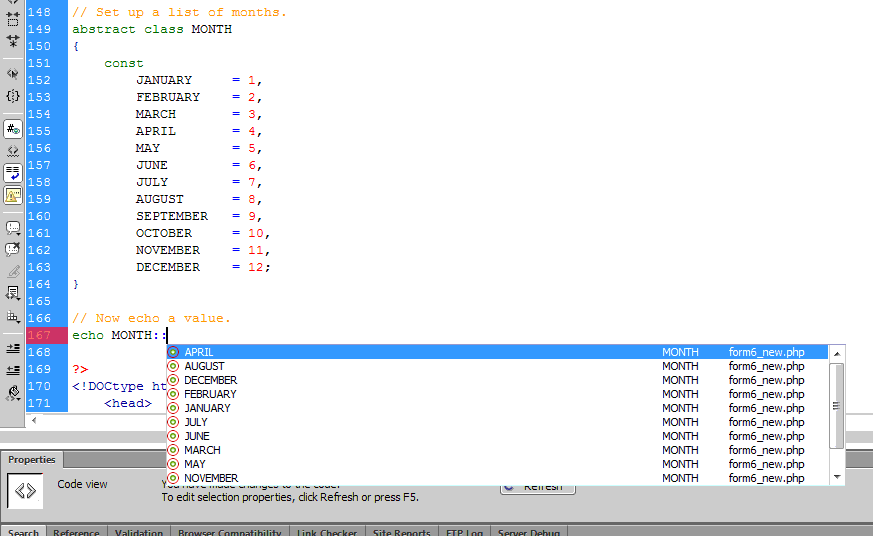
A few keystrokes and your IDE springs to action.

A few keystrokes and your IDE springs to action.

For most rudimentary enumeration needs this should prove more than sufficient, at least until the fine folks at PHP step up and provide us with the real thing.

Until next time!
DC

Quick Tip – Copy Table With Transact SQL

SQL

Here’s an easy one, but sometimes still troublesome for individuals testing the waters of SQL: How to quickly copy a table. There are lots of cases where you need to duplicate a table in all but name. Maybe you want the data as well, maybe not. Unfortunately this seemingly simple task is lacking as a functionality in most development tools – including the big boys like MS SQL Server Management Studio.

The good news is there’s a perfectly logical reason such a feature isn’t apparent: It’s part of SQL already, and super simple to boot. Here’s what to do:

SELECT * INTO schema.new_table FROM schema.existing_table

Execute this as a query and voila! You now have a duplicate of the old table, complete with data. Want to make a copy sans data? Just query for a non existent key value.

SELECT * INTO schema.new_table FROM schema.existing_table WHERE some_field = non_existing_value

It’s really that simple. No plug ins or complex write ups required.

Extra Credit

  • You needn’t copy every field. Swap out * with a list of desired fields, just like any other query.
  • Play with the WHERE cause a bit and you can copy portions of data rather than all or nothing. Again, to your SQL engine it’s just another query, so use your imagination.